
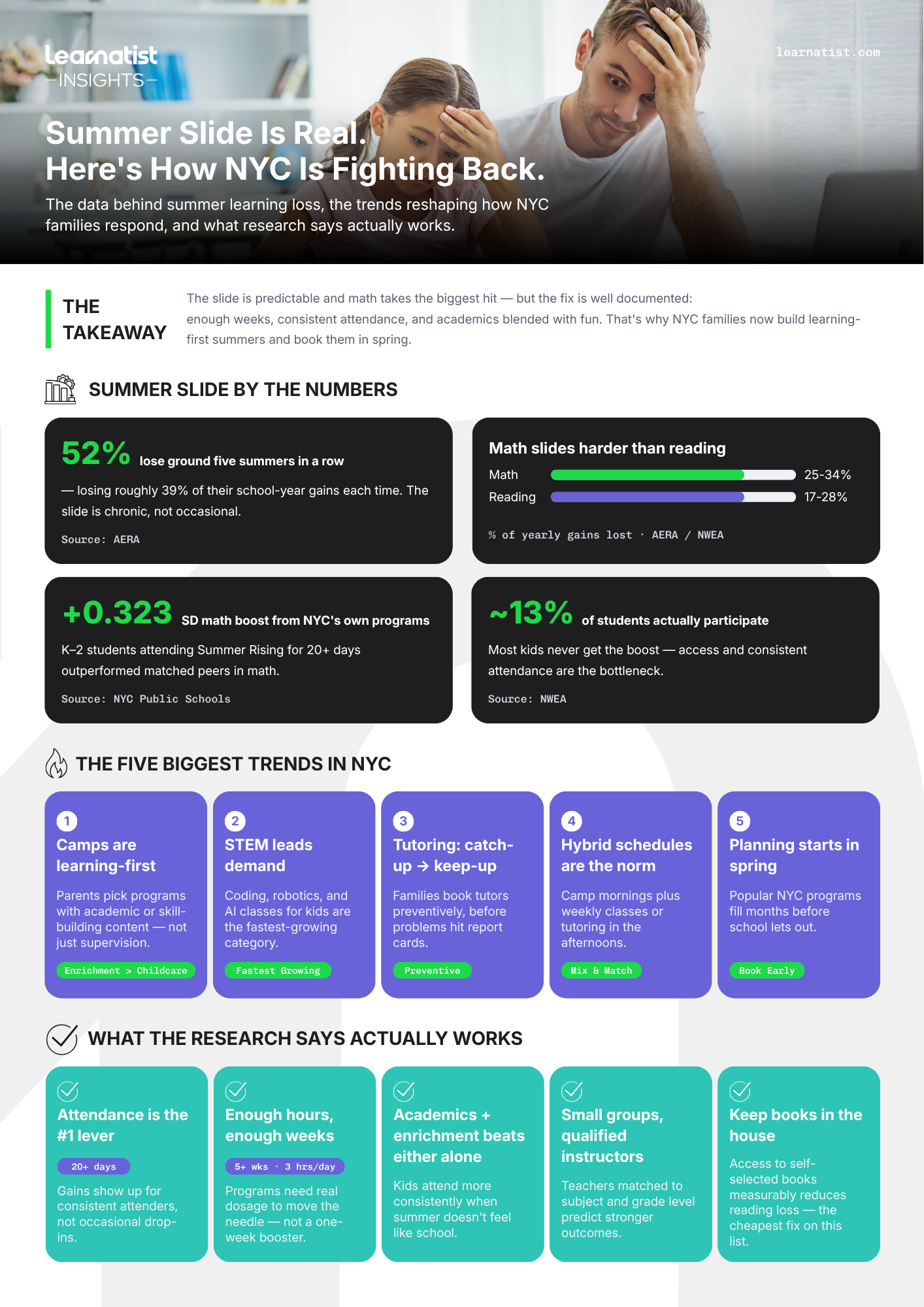
What happens to your child's math skills between June and September may be more significant than many parents realize. A large national study published in the American Educational Research Journal — tracking roughly 18 million students across all 50 states — found that 52% of students lost ground in five consecutive summers, giving back an average of 39% of their school-year gains each time. That risk is exactly what's driving the biggest summer learning trends in NYC: families are treating summer as part of the school year, not a pause from it.
In this Learnatist Insights report, we look at the data behind the shift. We cover how families use summer camps in New York City, enrichment classes, and tutoring to keep skills sharp. We also explain what the research says works — and what it means for your family.
Quick Answer: What Are the Big Summer Learning Trends?
Summer learning trends in NYC point in one clear direction. Families now combine camps, enrichment classes, and tutoring to prevent summer slide instead of waiting for fall report cards. Demand is strongest for STEM programs and preventive academic support. Here are the five trends at a glance:
- Camps are learning-first. Parents pick programs with academic or skill-building content, not just supervision.
- STEM leads demand. Coding, robotics, and AI classes for kids are growing fastest.
- Tutoring shifted from catch-up to keep-up. More families book tutors before problems appear.
- Hybrid schedules are the norm. Camp mornings plus weekly classes or tutoring sessions.
- Planning starts in spring. Popular NYC programs fill months before school lets out, so families now book camps, classes, and tutors well ahead.
Summer Slide by the Numbers
| Statistic | Finding | Source |
|---|---|---|
| Learning loss | 52% of students lost ground five summers in a row, losing ~39% of school-year gains each time | AERA |
| Math vs. reading | The average student loses 25–34% of math gains vs. 17–28% of reading gains over the summer | AERA / NWEA |
| Program impact | NYC K–2 students attending Summer Rising 20+ days beat matched peers by 0.323 SD in math | NYC Public Schools |
| Attendance matters | Only ~13% of students participated in summer programs in the districts studied | NWEA |
What Is Summer Slide, and How Big Is the Problem?
Summer slide is measurable learning loss during the break
Summer slide, also called summer learning loss, is the academic ground students lose when school is out. It shows up as lower test scores in the fall compared to the previous spring. Teachers then spend weeks re-teaching old material before new learning begins.
What summer learning loss statistics show
The most rigorous summer learning loss data comes from a 2020 study published by the American Educational Research Association, which analyzed test scores from nearly 18 million students in 7,500 districts nationwide. Key numbers:
- 52% of students experienced learning losses for five summers in a row
- Those students lost an average of 39% of their school-year gains each summer
- Depending on grade, the average student loses 25–34% of math gains and 17–28% of reading/ELA gains over the following summer
- In the most extreme cases, some students lost nearly 90% of what they'd gained the previous school year
Math is consistently the most vulnerable subject. Recent NWEA research comparing four national datasets confirms that summer score drops are typically larger in math than reading — likely because kids often keep reading over break, but rarely keep doing math. One honest caveat: researchers still debate how universal summer slide is, and estimates vary by test and grade. But the practical takeaway holds — an unstructured summer carries real academic risk, especially in math.
Does summer programming actually work? NYC has its own answer.
NYC Public Schools' own impact analysis of Summer Rising 2024 — comparing roughly 75,000 participants to matched peers — found that the program measurably stemmed summer learning loss in math. The most striking finding was about attendance: K–2 students who showed up 20 or more days outperformed similar non-participants by 0.323 standard deviations in math, roughly ten times the effect for the program overall. Gains were largest for English language learners and students in temporary housing.
The lesson for parents choosing any summer program: consistency beats enrollment. Signing up matters far less than showing up. National research points the same way — effective programs run at least five weeks with several hours of daily academic time, while the typical district program runs only three to four weeks.
Which students are most affected
Research suggests summer slide hits some students harder than others. Older elementary and middle school students often show larger losses than younger children. Students without access to books, enrichment, or structured programs face wider gaps. One honest caveat: researchers still debate the exact size of these effects. The direction of the findings, however, is consistent — unstructured summers cost learning.
What Are the Biggest Summer Learning Trends in NYC?
The summer learning trends in NYC reflect a citywide shift in how families think about the break. Here are the five patterns we see across the market.
Trend 1: Camps are becoming learning-first, not just childcare
Traditional day camps still fill fast. But more families now choose camps with a clear learning thread — STEM camps, art camps, nature programs, and academic-enrichment hybrids. The question parents ask has changed. It's no longer "Will my child be safe and busy?" It's "What will my child walk away knowing?"
Trend 2: STEM, coding, and robotics lead demand growth
STEM is the fastest-growing corner of NYC summer learning. Coding, robotics, game design, and AI classes for kids draw strong interest across boroughs. Parents see these programs as double-duty: they keep math and logic skills active while building future-ready competencies. Minecraft and Roblox coding programs make the entry point feel like play, which helps reluctant learners say yes.
Trend 3: Summer tutoring shifts from catch-up to keep-up
This may be the most telling trend. Tutoring was once a response to a bad report card. Now many families book math tutoring for kids preventively — one or two sessions a week to hold skills steady. The logic tracks the research. Since math slides most, light and consistent practice beats a stressful September scramble.
Trend 4: Families build hybrid summer schedules
Few NYC families choose just one option. A common pattern looks like this:
- Weeks 1–4: Day camp or STEM camp, mornings to mid-afternoon
- Weekly: One or two tutoring or enrichment sessions
- August: Lighter structure — travel, library visits, reading routines
Hybrid schedules solve two problems at once. They cover working-parent hours and keep learning consistent without filling every day.
Trend 5: Demand varies by borough and age group
Summer learning demand is not uniform across New York City. Test-prep-adjacent tutoring interest concentrates among families with rising middle schoolers, where SHSAT timelines loom. STEM camp interest runs strong in Manhattan and brownstone Brooklyn, while demand for affordable hybrid options is notable across Queens and the Bronx. Elementary families lean toward camps; middle school families add tutoring. Providers who offer flexible weekly enrollment fit NYC family schedules best.
Why Do NYC Families Invest in Summer Learning?
The data shows what families do. Understanding why NYC families invest in summer learning explains where the trend is heading.
Academic confidence and school-year readiness
Parents consistently name confidence, not grades, as the first reason. A child who starts September on solid footing feels capable in week one. That early confidence shapes the whole term. Summer learning is less about getting ahead and more about not starting behind.
The competitive NYC school environment
New York City's school landscape adds local pressure that national data misses. Gifted & Talented programs, selective middle schools, and the SHSAT create real timelines. Families with rising 6th and 7th graders often use summer to build skills before test prep formally begins. This is a distinctly NYC driver of summer learning demand.
Working-parent schedules meet learning goals
For many families, the honest answer is both practical and academic. Parents need coverage during work hours. A structured program that also teaches something feels like better value than supervision alone. The Afterschool Alliance reports that unmet demand for summer programs remains high nationally — for many families, the barrier is access and cost, not interest.
What Does the Research Say Actually Works?
Trends tell you what families do. Research tells you what helps. Three findings stand out.
Program length and consistency matter most
The RAND Corporation's summer learning studies, funded by the Wallace Foundation, followed thousands of students in voluntary summer programs. Students with high attendance in five-to-six-week programs showed measurable math gains that persisted into the school year. The takeaway is simple: showing up consistently beats intensity. A few steady weeks outperform a cram week.
Balance matters — kids still need unstructured play
Structured learning should not swallow the whole summer. The American Academy of Pediatrics emphasizes that play is essential to healthy brain development, executive function, and stress regulation. Downtime is not wasted time. The strongest summer plans mix learning blocks with genuine free play, rest, and boredom.
What this means for choosing a program
When comparing options, the research points to a short list of what matters:
- Duration: Look for programs running several weeks, not just days
- Attendance fit: Choose a schedule your family can actually keep
- Engagement: Prioritize programs kids enjoy — enjoyment drives attendance
- Qualified instructors: Teaching quality mattered in every study
- Your child's interests: A robotics-loving kid learns more at a robotics camp than at a generic one
What Should Education Providers Take Away?
For the schools, camps, tutors, and learning centers reading this, the trend data carries four signals:
- Lead with learning outcomes. Parents choose programs that state clearly what children will gain.
- Offer hybrid-friendly formats. Weekly sessions and half-day options fit how NYC families now build summers.
- Meet STEM demand. Coding, robotics, and AI programming remain the strongest growth categories.
- Serve every borough. Unmet demand outside Manhattan represents the largest open opportunity.
Final Thoughts for Parents: Summer Learning Trends in NYC
Key takeaways:
- Summer slide is real but preventable — a few consistent weekly hours make a measurable difference
- Engagement beats drilling — kids attend programs they enjoy, and attendance drives results
- Fit matters more than prestige — match the program to your child, not the other way around
- Protect free play — rest and boredom belong in a healthy summer too
The summer learning trends in NYC don't mean you need to fill every week. Start with your child's interests, add consistency, and leave room to breathe. If you're comparing options, browse summer camps in New York City, explore academic tutoring for kids, or ask other parents in the Learnatist Parent Q&A Forum. A good-fit summer beats a full one.
Frequently Asked Questions
- What is summer slide and how much learning do kids lose?
- Summer slide is the learning loss students experience over break. A national study of ~18 million students found the average student loses 25–34% of their school-year math gains and 17–28% of reading gains over the following summer — and more than half of students lost ground five summers in a row.
- Do summer camps really prevent learning loss?
- Camps with learning content can help. RAND research found students with high attendance in multi-week summer programs showed math gains that lasted into fall. Consistency and engagement matter more than the camp label.
- How many hours of summer learning does a child need?
- There's no magic number, but research favors consistency over intensity. A multi-week program plus one or two weekly practice sessions outperforms short, intense bursts.
- Is summer tutoring worth it if my child isn't behind?
- For many NYC families, yes. Preventive tutoring — one or two light weekly sessions — holds math and reading skills steady, so September starts with confidence instead of review.
- What are the most popular summer programs for kids in NYC?
- STEM camps, coding and robotics classes, learning-focused day camps, and preventive tutoring lead current demand. Many families combine a camp with weekly enrichment in a hybrid schedule.